Showing posts with label bahai. Show all posts

Monday, April 2, 2012

The Centenary of an Important Visit to the United States of America


Click On Me!

The year 1912, said US presidential candidate Eugene Debs, “is a year supreme with possibilities.” A fiercely contested election challenged Americans to decide what kind of country they wanted. Minorities and women fought for civil rights. Workers faced off against corporations. Soldiers landed on foreign shores, sparking debate on the nation’s role in the world. Did Americans really believe—like Theodore Roosevelt— that “The welfare of each of us is dependent fundamentally upon the welfare of all of us”?
On April 11, 1912, a new voice joined the conversation. It belonged to ‘Abdu’l-Bahá.
It was the unlikeliest of voices. ‘Abdu’l-Bahá had just been released by the Turkish government after 40 years as a prisoner of conscience. For 239 days he traveled across America, speaking about issues that still define us. He reached across political, religious, racial, class, and gender lines to confront Americans with a vision of human nature, social unity, and the nation’s future that was 100 years ahead of its time.
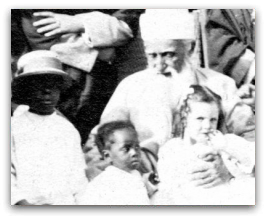
Prejudice is a Learned Behavior

In 1912, the country was torn with racial division, and “separate but equal” was the highest level of interracial relations to which the nation aspired. ‘Abdu’l-Bahá challenged America to go beyond tolerance, to embrace diversity completely, and to demolish racial barriers in law, education and even marriage.


Unity in Diversity: Watchword of the Bahá'í Community


Perhaps the most prominent social message that ‘Abdu’l-Bahá brought to the West was the need for international peace, which he called “the most momentous question of this day.” While much of the popular discussion involved the political requisites to peace, ‘Abdu’l-Bahá focused on social and spiritual issues, linking universal peace with such topics as women’s suffrage, a world tribunal, collective security, the necessity of religious unity and the need for justice.


'Abdu'l-Bahá Called for Greater Education and Opportunity for Women


‘Abdu’l-Bahá described gender equality through the powerful analogy of a bird attempting to fly:
The world of humanity is possessed of two wings: the male and the female. So long as these two wings are not equivalent in strength, the bird will not fly. Until womankind reaches the same degree as man, until she enjoys the same arena of activity … humanity cannot wing its way to heights of real attainment.
Ending Extremes of Wealth and Poverty

On the eve of ‘Abdu’l-Bahás journey across America, a new industrial order had emerged, creating nationwide prosperity, but also exacerbating crushing poverty and inequity. Publishers and industrialists grew very wealthy providing newspapers, magazines, automobiles and steel, building the railroads that crisscrossed the U.S. and the ships that transported American manufactured goods to Europe. In the midst of such vast wealth, the poor languished in crowded and often disease-ridden urban housing. The first decades of the 20th century saw huge numbers of children working in mines, glass factories, textiles, agriculture, canneries, and as newsboys, messengers, bootblacks, and peddlers. In 1904, the National Child Labor Committee was formed and a national child labor reform campaign began, but a law to actually prevent child labor would not be passed by Congress until the mid 1930s.
The year 1912 saw America with a population of 92 million, with a low 2% unemployment rate, but the chasm between the wealthy and the poor was impassible. Workplaces were profoundly unsafe. On the railroads alone, between 1890 and 1917, 72,000 workers were killed and more than 2 million injured. In addition, there was no social safety net—worker’s compensation was a new idea, passed by just 10 states by 1911. Neither Social Security, Medicare, nor Aid to Families with Dependent Children existed—so the elderly, widows, orphans and the ill were left to their own devices, meager as they were. Partly due to these social disparities, worsened by poor sanitation and a lack of good public health practices,U.S. life expectancy was on average just 48 years for men and 52 years for women.
Labor unions grew in size and influence as the middle classes became more unhappy and restless with the status quo. Poverty was on the rise, industrial monopolies continued to increase despite the Sherman Antitrust Act of 1890, safety for workers in the workplace was largely dismissed as irrelevant, and children were in the workplace in their thousands. Nearly 20% of urban children were undernourished and only one-third were enrolled in elementary school. Immigrants had flooded the cities, many—including Poles, Finns from Russia, and Macedonians and Bulgarians from Turkey—fleeing political or religious oppression. Others, like the Irish, fled famine and poverty, swelling the ranks of the poor.
Social reforms in the 1940s took the first small steps to redress these inequities through the Social Security system, whereby the aged would receive an income set aside from their earnings, and the poor would receive medical care. The U.S. GI bill after World War II enabled thousands of returning military men and women to obtain college degrees and rise to serve their countries in all the professions.


Below are some great links to obtain more information:

239 Days In America

US Bahá'í Community: Commemoration of the Centenary of 'Abdu'l-Bahá's Visit to America

Talks Given by 'Abdu'l-Bahá

Portraits of 'Abdu'l-Bahá

Photographs of 'Abdu'l-Bahá in the West

239 Days: 'Abdu'l-Bahá's Journey in America, By: Allan L. Ward

An Excerpt from 239 Days: 'Abdu'l-Bahá's Journey in America:

Chapter 2

First Days in America: New York City

The next day was Thursday, April 11, 1912, 'Abdu'l-Bahá's first day in America. As the Cedric came up the bay, reporters went out on the tugboat to board the ship at quarantine in order to interview 'Abdu'l-Bahá. Among them was Wendell Phillips Dodge, of the New York City News Association, whose report was sent out through the Associated Press. He wrote:
When the ship news reporters boarded the Cedric down the bay 'Abdu'l-Bahá was found on the upper deck, standing where he could see the pilot, his long, flowing oriental robe flapping in the breeze... His face was light itself as he scanned the harbor and greeted the reporters. His first words were about the press, saying: "The pages of swiftly appearing newspapers are indeed the mirror of the world... But it behooveth the editors of the newspapers to be sanctified from the prejudice of egotism and desire, and to be adorned with the ornament of equity and justice."

When the ship was abreast the Statue of Liberty, standing erect and facing it, 'Abdu'l-Bahá held his arms wide apart in salutation, and said: "There is the new world's symbol of liberty and freedom. After being forty years a prisoner I can tell you that freedom is not a matter of place. It is a condition. Unless one accept dire vicissitudes he will not attain. When one is released from the prison of self, that is indeed a release."... The ship now pointed its nose up the North River, and gazing ... at the ... skyscrapers, (He said): "These are the minarets of Western World commerce and industry... The ship now reached its pier, where were anxiously waiting several hundred Bahá'ís ... who had been craning their necks down the river for a first sight of him since early morning.'

- Please enjoy this wealth of information.


Click On Me!

A Photograph of 'Abdu'l-Bahá

‘Abdu’l-Bahá’s journeys in America lasted 239 days between April and December 1912. While much of his time was spent in the major metropolitan centers of the country, a number of small towns were also on the itinerary, and indeed ‘Abdu’l-Bahá never seemed to be as interested in material development as in spiritual capacity. Most of His cross-country travels were by train, which was the most convenient form of long-distance travel at the time. He spent 10 days in Canada, and a little over a month on the West coast, with the rest of the time shared among the cities and towns of the Eastern and Central United States.


For more information about the cities 'Abdu'l-Bahá visited: http://centenary.bahai.us/cities
---------

Below is a video that contains 'Abdu'l-Bahá's message in more depth, concluding this article. Please enjoy.


Wednesday, January 12, 2011

The Difference Between Animals and Humans


In today’s current society there are numerous separate kingdoms, genera, and species in the world. However a basic generalization of all these organisms are the mineral, vegetable, animal, and human kingdoms in this world. Although these kingdoms may have some similarities, there is a major difference between the human kingdom and the rest of the kingdoms in the world of nature. The difference between mankind and the other life forms in nature is free will, which is made apparent through the existence of the human spirit.

Free will is given to all humans through their ability to make a choice and decide on their fate whether they use it for good or bad. However, “Nature is subjected to an absolute organization, to determined laws, to a complete order and a finished design, from which it will never depart.” (1) While humans in and of themselves have the power to “resist and oppose nature because he discovers the constitution of things…” (1) Since saying that since humankind is not subject to this set design, humans may do what they please.

Nature itself has no intelligence nor will for it cannot make any decisions because it has no soul. For example, “the nature of fire is to burn” (1) and “the nature of water is fluidity; it flows without will or intelligence.” However, man has free will hence leading to numerous inventions, which are due to the discovery of the constitution of nature. For instance, the discovery of the basic principles of physics have allowed us to currently create vast and incredible things, and the discovery of viruses and bacteria have allowed us to invent vaccines and cures for certain diseases.

Therefore, mankind must consider this single idea: if humans have been created with free will and souls, should man not act more proper than common animals. Unfortunately, as our knowledge of the constitution of nature grows so does our free will, thereby allowing humans to commit more wrongs than rights. As it is written in The Hidden Words:

“O SON OF SPIRIT! Noble have I created thee, yet thou hast abased thyself. Rise then unto that for which wast created.”(2)

May the peoples of the world grow and develop to enable humanity to become a noble being; and use their free will to not simply profit themselves like simple animals, but to profit the entirety of creation.


References

1) (Abdu'l-Baha, Some Answered Questions, pgs. 3-4)
2) (Baha'u'llah, The Hidden Words from Arabic, number: 22)

Wednesday, June 16, 2010

Bahá'í Outline of Education

In today’s current society education is most often mistaken with instruction. The purpose of instruction is to transfer knowledge from one person to another, much like children and their teachers at school. When one is properly educated this individual will truly understand himself and the world around him. The lesson being taught to the child will also have a profound effect on the child, and make him or her more useful to mankind. The Bahai view upon the purpose of education is that every individual should be considered as a treasure house in which God has deposited jewels that should be manifested through the process of education, thereby benefiting mankind.
Unfortunately, numerous universities do not delve within a child’s mind and attempt to discover the potential within. The most frequent thing done is that if a child cannot learn the material it is presented then he or she will be left behind. The children who eventually are left behind become neglected and therefore left in a wilderness of ignorance. Numerous types of these children will eventually participate in unscrupulous actions and other various wrongdoings due to their lack of true education.
However, each child has a true potential to be manifested through proper education. For example, there was once a king of India who had four sons and wished for his sons to have private tutoring in subjects such as philosophy, mythology, and other subjects for that time period. The teacher had given them a sentence to memorize and write one hundred times for the first lesson and the sentence was “Don’t ever grow impatient, no matter the circumstances, and keep smiling.” After the first lesson one of the four boys reported to the teacher that he had not yet learned the phrase, but the teacher did not wait and continued to teach the other students.
After some months had passed, the king and some ministers had attended class with the four boys. The teacher first explained and said that, “These three boys have advanced very much. They have memorized so many books and homework, but alas, your majesty, this one has not yet learned the first sentence I have given him.” The kind and one of his ministers had rebuked him for his ignorance and lack of success. However, the child had kept on smiling and patiently listening while they yelled at him. His teacher had then discovered that this child was the one who had truly learned and had said, “Your majesty, he is the one who has learned. The others only have memorized.” Thereby, exemplifying the importance of proper education and not instruction in today’s society.
Although the path to true education may not be a viable option currently. The difference between instruction and education must be known for humanity to truly prosper. The children of this century each have numerous qualities waiting to be manifested, but only through the proper education process and not pure memorization. Hopefully, the world will recognize each child’s potential and properly educate each child so that they may be beneficial to the prosperity of humanity.

Saturday, June 5, 2010

The Oil Spill Sends A Call For Change


With an oil spill that has been sending oil into the ocean for over a month, a severe threat is presented to the marine life, the local economy, and the future of the oil industry. With such a disaster like the oil spill, the destiny of the world hangs in the balance. The formation of methane ''ice crystals'' (formally known as a methane hydrate) along with the inaccessibility of the oil pipe has created a virtual disaster for BP in its efforts to stop the flow of oil into the Gulf of Mexico. The demise of BP can be possible with the propable legal actions to ensue.
The legal problems that BP faces is only a glimpse of the waning oil industry. The need for a global change in the reliance on oil, particularly in the USA, is an issue to be dealt with. The increase in the production of alternative fuels is a necessity to drive the world in a new direction. The picture below stands as a testimony to the horrors of this oil spill and those to occur in the future.

(This photo is courtesy of NewsWeek)

The world must realize that sacrificing the world's natural resources is not worth the short term energy gains from oil. The peoples of the world must realize that the short term gains are not worth the long term losses. Sometimes, the best choices are not the easiest to carry out. In this case, it is clearly visible that offshore drilling is not the remedy to an addiction on oil. More people are using more energy everyday. If the energy capacity of the world needs to grow to meet demand, proper actions must be carried out. A revision in the energy infrastructure of the world is neccessary. The future starts today.

This disaster in the Gulf of Mexico might not be in vain. The possibilities of change are apparent. As a global community, everyone can learn from their mistakes and work together to create a better world. This oil spill is a wake-up call to the world. The world can learn from all of the aspects of the oil spill, and avoid another. The future belongs to everyone, and it is the responsibility of all to ensure a good one.

A Word of Wisdom
O SON OF MAN!

My calamity is My providence, outwardly it is fire and vengeance, but inwardly it is light and mercy. Hasten thereunto that thou mayest become an eternal light and an immortal spirit. This is My command unto thee, do thou observe it. -Baha'u'llah (From the Hidden Words of Baha'u'llah)

Oil Location Forecast

Wednesday, May 5, 2010

Alternatives to consumer culture focus of new Baha'i document | Bahai Faith | Baha'i Faith

Alternatives to consumer culture focus of new Baha'i document | Bahai Faith | Baha'i Faith

Today, it is well-known that a consumer culture is dominating the world stage. Businesses compete with one another to exploit people everyday to come and buy their product. Many can argue that this highly competitive atmosphere is just business as usual. On the other hand, a rift is forming between producers and consumers. Producers are producing more while consumers are consuming more until they can no longer.

There is one question: can prosperity be achieved solely through the accumulation of wealth or belongings?

The International Baha'i Community is addressing this issue. Click on the link above below the title of this article to find out more.


Sunday, January 31, 2010

A Full Circle

     Nature. From the beginning, humanity has relied upon nature for it's sustenance. Since the beginning of the industrial revolution, humanity has denied the environment the rights it has had before humans existed. To maintain natural equilibrium, our world's climate will act in ways some people consider unnatural. Remember, the environment will do whatever it can to maintain eqilibrium whether humans exist or not.
    
     Today, the peoples of the world are beginning to realize that the very practices humans had when they were in equilibrium with nature is once again necessary. The global civilization humans have created is going full circle by embracing nature and adopting sustainable practices.Terra Plancha is a marvelous invention by the ancient Amazonian civilizations to aid them to survive in environments
where the soil is poor for agriculture. To this day, scientists cannot fathom how artificial soil as rich as Terra plancha was created. That old practice scientists are trying to discover will lead to the rebirth of a dying Amazon Forest. As subsistence farmers stop burning it down for more land to farm, they will be able to settle in one place and utilize that necessary agricultural tool.

Today, scientists are trying to recreate a revolutionary agricultural practice that will once again equip farmers to farm in sustainable ways where the equilibrium, that is so necessary between nature and humans, will be maintained. Not only will Brazilian farmers utilize previously unusable farmland, but so many desperate countries around the world can utilize the art of making and distributing Terra Plancha over infertile ground.
    
     In terms of architecture and other forms of engineering, practices are being adopted that copies the already successful ways of nature.
To the left is the famous Baha'i Temple in Santiago, Chile. It has won many awards for its revolutionary design and has been labeled the "Temple of Light." This magnificent building that is under construction incorporates many aspects from nature. The natural beauty and the design of this building is phenomenal. The location of this temple will be in the mountains providing a meditational atmosphere for the temple itself and the gardens that surround it. The power and influence that such a building will have on the people who visit it will be far greater than most of the myriad of sacred spots around the world.

     Last, governments are starting to plan and build "green" buildings that will not only save money and resources, but it will maintain the important balance between innovation and nature. Humanity is entering uncharted waters as it will enter an increasingly warmer world, as the overall trend shows. Despite the flux of extreme weather with floods, droughts, heat waves, and cold spells; it should be remembered that this living Earth is only trying to maintain equilibrium. Humanity has invented many new things and we now posses the technology to literally change the world- an ability that no generation before this one can rival.
    
     On question remains. Are we ending our journey on this planet, or are we starting a new one that permeates with a new spirit? That  question remains to be answered by the people that live on this planet- one decision at a time.
O YE THAT ARE LYING AS DEAD ON THE COUCH OF HEEDLESSNESS!

Ages have past and your precious lives are will-nigh ended, yet not a single breath of purity hath reached Our court of holiness from you. Though immersed in the ocean of misbelief, yet with your lips ye profess the one true faith of God. Him whom I abhor ye have loved, and of My foe ye have made a friend. Notwithstanding, ye walk on My earth complacent and self-satisfied, heedless that My earth is weary of you and everything within it shunneth you. Were ye but to open your eyes, ye would, in truth, prefer a myriad griefs unto this joy, and would count death itself better than this life. 

-Baha'u'llah